
By Daniel Lopez, Church Realty
Against the backdrop of the broader decline of Biblical Christianity in America, recent research from Barna and other organizations has revealed several encouraging trends for the Church. Bible sales, for example, have risen 41.6% since 2022. Spiritual app downloads are up 79.5% since 2019, and Christian music streaming has increased by 50% during the same period.
Even more significantly, the number of Americans who say they have a personal commitment to Jesus that remains meaningful in their lives has risen by 12 percentage points between 2022 and 2025. Anecdotally—and increasingly through measurable data—it appears that some long-standing patterns of decline may be beginning to reverse. While it may be premature to call this a “revival,” more people seem willing to explore Christianity for the first time or return to a previously abandoned faith.
The word that best captures what is happening in the spiritual landscape of the United States today is disruption. Old paradigms of ministry, spirituality, and religious practice are giving way to new expressions of faith and community. For the purposes of this article, I want to highlight three major disruptions that every pastor and Christian leader should understand in order to minister effectively in this rapidly changing environment.
1. The “Age” Disruption: Fewer Christians Are Practicing Their Faith—Yet Younger Generations Are Returning to Church
Current research indicates that nearly half of all U.S. adults now identify as non-practicing Christians. Today, only 54% of self-identified Christians say that faith is central to their lives, compared to 74% in 2000.
That means nearly half of American Christians no longer consider faith to be a defining priority in daily life—a sobering reality that points to a growing discipleship crisis.
At the same time, however, there is an unexpected and hopeful development emerging among younger generations. Gen Z (those born between 1997 and 2012) is now the demographic with the highest church attendance frequency, averaging 1.9 church visits per month. That figure is slightly higher than Millennials and significantly higher than Gen Xers and Baby Boomers. The following chart is very instructive:
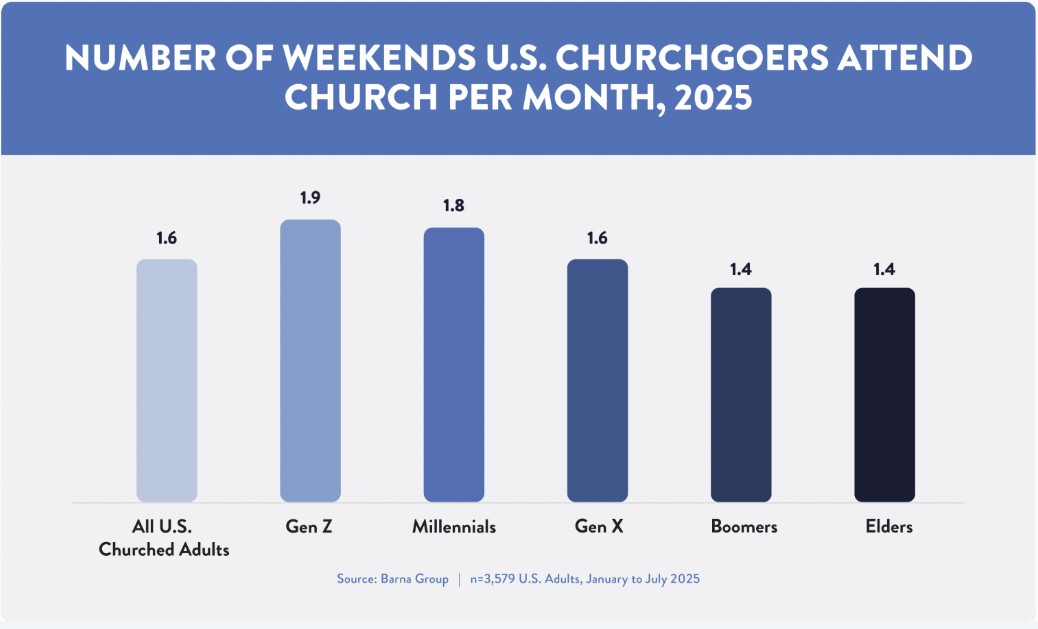
This trend represents a remarkable reversal of expectations. For years, younger generations were assumed to be drifting permanently away from organized religion. Instead, many young adults now appear to be searching for meaning, identity, stability, and spiritual grounding in a culture increasingly marked by confusion and fragmentation.
Still, the challenge remains substantial. Only 24% of Christians actively practice their faith today. Fifteen years ago, practicing Christians outnumbered non-practicing Christians. Today, the opposite is true. This reality may help explain the broader crisis of discipleship, biblical literacy, and even the intense partisanship shaping modern society.
2. The “Gender” Disruption: Young Men Are Returning to Church While Women Are Leaving
Another surprising trend—one that has accelerated dramatically over the past five years—is the growing gender reversal in church engagement.
Historically, men were considered the more difficult group to reach spiritually, while women generally gravitated more naturally toward the relational and communal aspects of church life. Today, however, the pattern appears to be shifting. Increasingly, young men are returning to church while many women are disengaging from organized religion.
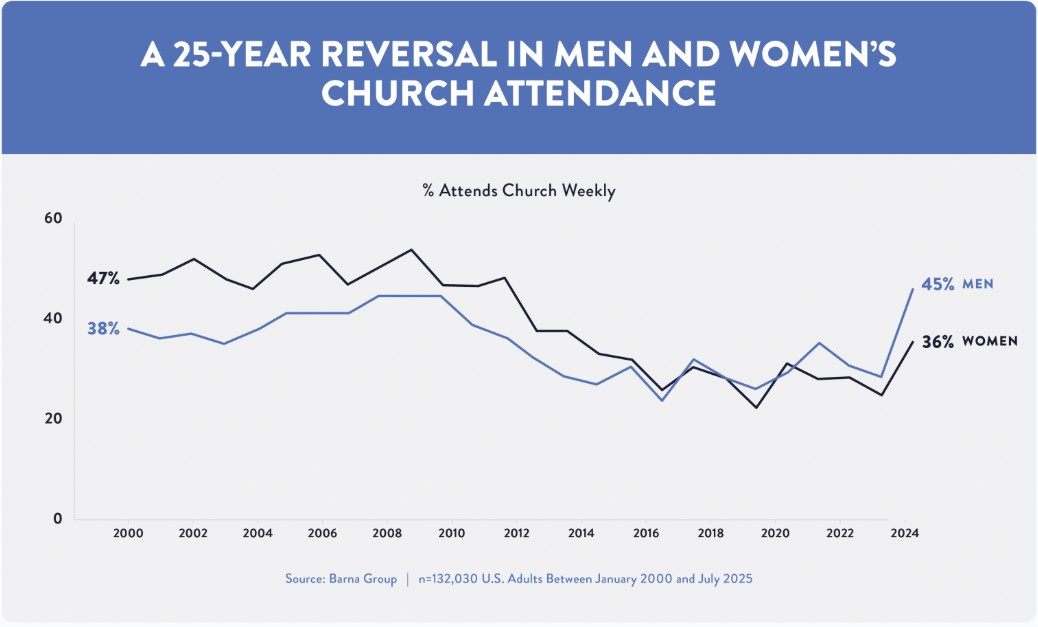
Researchers have proposed several explanations for this reversal. Some point to the dramatic rise in educational attainment among women, who now earn the majority of bachelor’s degrees in the United States. Others see a cultural and political dimension. In an era when many young men feel culturally marginalized or criticized, some may view the church as one of the few remaining institutions that still affirms and encourages positive expressions of manhood.
At the same time, as women continue advancing into leadership roles throughout business, academia, and government, some may increasingly perceive the Church as an institution that does not fully recognize or value their contributions and aspirations.
Whatever the causes, this shift presents both opportunities and challenges for church leaders. Ministries that fail to understand these changing dynamics risk becoming disconnected from the very people they hope to reach.
3. The “Digital” Disruption: Evangelism and Discipleship in the Age of Algorithms and AI
There was a time when access to biblical teaching and Christian content was a primary reason people attended church. People gathered to hear gifted preachers and Bible teachers because access to that kind of teaching was limited.
Today, however, we live in a world saturated with content. Sermons, podcasts, devotionals, theological debates, and worship music are instantly available to anyone with a smartphone. As a result, the primary motivation for gathering physically has shifted away from content consumption and toward something more relational and experiential: fellowship, encouragement, prayer, accountability, and authentic spiritual community.
David Kinnaman of Barna Research has observed that many people today are being discipled more by algorithms than by pastors. Before the average church attendee even walks into a Sunday service, they may have already spent nearly 49 hours that week consuming digital media shaped by algorithms designed to reinforce attention and behavior patterns. In that environment, a 30-minute sermon and a small group meeting face enormous competition for influence.
In response, both evangelism and discipleship methods are evolving.
In some ministry circles, evangelism has become more direct and public than in previous decades. Rather than relying primarily on long-term relational approaches, many churches and ministries are returning to bold public appeals for repentance and faith. This can take the form of large evangelistic gatherings, street preaching, social media outreach, digital apologetics, or more intentional personal evangelism.
Likewise, preaching and teaching are becoming less centered on information transfer alone and more focused on facilitating an encounter with God and meaningful interaction within the body of Christ. This shift may influence everything from room design and church architecture to ministry formats, discussion styles, and the balance between large gatherings and smaller, interactive communities.
Conclusion
Disruption is unfolding across the Church world in multiple, interconnected ways. Demographic patterns are shifting. Gender dynamics are changing. Digital technology and artificial intelligence are reshaping how people think, learn, communicate, and even form spiritual identity.
For pastors and church leaders, the challenge is not to change the core message of the Gospel, but to understand the times and adapt methods of ministry wisely and faithfully. The message remains timeless, but the methods of communication, discipleship, and outreach must continue evolving in response to a rapidly changing culture.
These disruptions may also significantly impact how churches think about physical space and property in the years ahead. For more than 30 years, Church Realty has worked alongside local congregations to help them navigate these changing realities and make wise decisions regarding their real estate and ministry needs moving forward.
Call us today at (281) 744-0644 or contact us here for a free and confidential consultation, thank you!
AVAILABLE CHURCH PROPERTIES
Propiedades Disponibles